
Asin Tibuok: The Salt That Is Made in a Clay Pot
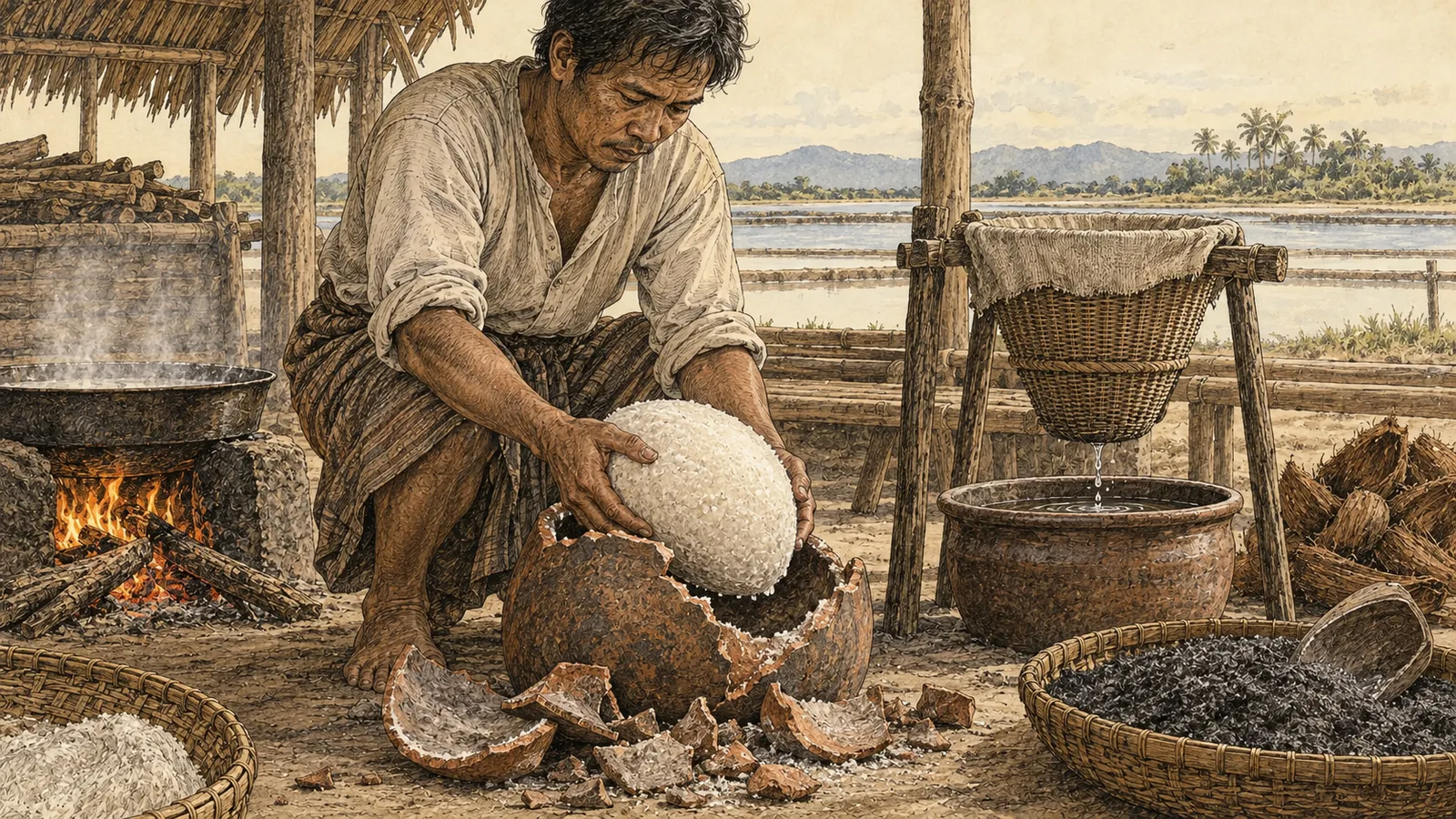
Asin tibuok is a Philippine sea salt made by soaking coconut husks in seawater for roughly three months, burning them to ash, filtering seawater through that ash to make brine, and boiling the brine in a hand-made earthenware pot until the salt sets as one solid mass and the pot gives way. In December 2025 UNESCO inscribed the practice on the List of Intangible Cultural Heritage in Need of Urgent Safeguarding — the risk register, not the honours list. Three months earlier the Philippine intellectual property office registered “Alburquerque Asin Tibuok” as the country’s third geographical indication, and it covers one town.
What the name describes
Asin is salt. Tibuok is usually glossed as whole, or unbroken. That is the distinguishing fact: the salt leaves the fire as a single ovoid lump of roughly a kilogram rather than as loose crystals. UNESCO’s own summary puts it plainly — the finished object “resembles a white egg inside a brown shell.” The brown shell is what is left of the pot.
English-language coverage almost always calls it the dinosaur-egg salt. That phrase is a handle built for foreign readers. It is not a Boholano description, and it does more work for importers than for the households doing the work.
The process, in order
Every step below comes either from UNESCO’s element description or from the makers’ own published account and from reporting by journalists who watched a batch. Where the two disagree on duration, we say so rather than picking one.
- Coconut husks are soaked in seawater. The producers’ own site says three months, in pools beside the mangrove. UNESCO says only “months”.
- The husks are lifted out, sliced and dried for a day or two.
- They are burned in a controlled heap over about three days, with seawater poured onto the burning pile throughout, so the ash ends up carrying salt rather than burning clean. The salted ash has a name: gasang.
- The ash goes into large cone-shaped filters — buri leaf in one account, a bamboo funnel tank in another — and seawater is percolated through it, in stages. What runs out at the bottom is a concentrated brine, tasik.
- The brine is fed continuously into earthenware pots set over a fire, for something like eight hours at a stretch. Reporting from the site describes three such days to finish a batch.
- The salt consolidates inside the pot, the pot fails, and the piece is left to cool overnight before it is taken out.
Read those durations for what they are. They are practitioners describing their own working method, repeated by reporters who stood next to the fire. They are not a written specification with tolerances, and nobody has published one. The figure that appears consistently, and the one that decides the economics, is the total: a batch takes a minimum of about three months from first soaking to finished salt.
Two things in that sequence are worth pausing on. The ash is not fuel residue being reused for convenience; it is the filtration medium, and salting it during the burn is the step that makes the whole thing work. And the brine is never concentrated by sitting in the open. This is a coastline with a wet season. The concentration is done by ash and by fire, the same structural answer that wet-climate producers reach for everywhere.
Why the pot does not survive
Accounts differ on the mechanism, and the disagreement is worth stating. One published account has the salt expanding as it forms and cracking the pot from the inside. Another describes the clay mould as already partly broken by the heat of the fire by the time the salt is freed. Both describe the same outcome: the vessel is consumed by the batch it holds.
That is a bigger fact than it sounds. A pot is not reusable, so every unit of salt carries a pot, the clay for the pot, and the labour of forming and firing it. In the Christian Science Monitor’s photographs of the Manongas operation the mould-maker is a separate named person from the salt-maker. This is a manufacturing constraint, not a ceremony, and it is one of the main reasons the method will not scale.
What UNESCO inscribed, exactly
The element is “The practice of making Asin Tibuok, the artisanal sea salt of the Boholano of Bohol Island, Philippines”, inscribed by decision 20.COM 7.A.6 at the twentieth session of the Intergovernmental Committee for the Safeguarding of the Intangible Cultural Heritage, held in New Delhi in December 2025.
The choice of list is the point. UNESCO keeps two main intangible-heritage lists. The Representative List is a showcase. The List of Intangible Cultural Heritage in Need of Urgent Safeguarding is for practices judged to be at serious risk of disappearing, and inscription commits the State Party to a safeguarding plan. Coverage that reports this as an award has the direction of travel backwards.
UNESCO lists ten threatening factors against the element, and the full list is worth reading rather than the tidier half of it that tends to get quoted: aged practitioners, arduous training, climate change, diminishing participation, diminishing youth interest, few practitioners, insufficient remuneration, repressive policies, rural-urban migration and water pollution. Insufficient remuneration is doing a great deal of work there. So is repressive policies, which is the one term on the list that neither the element file nor any of the coverage we have read explains, and we are not going to guess at what it refers to.
The geographical indication covers one municipality
On 3 October 2025 the Intellectual Property Office of the Philippines announced registration of “Alburquerque Asin Tibuok” under certificate number G/4/2024/00008. It is the third geographical indication the Philippines has registered, after Guimaras mangoes and Aklan piña.
Note the first word. The protected name is tied to Alburquerque, a municipality on Bohol’s south coast. It is not tied to Bohol, and it is not a protection of “asin tibuok” as a category. Salt made by the same method in a neighbouring town is still asin tibuok. It is not Alburquerque Asin Tibuok.
The registration is held by the town. IPOPHL’s announcement of 3 October 2025 records the certificate being turned over to the local government unit of Alburquerque, with two municipal councillors named as receiving it. It is a municipal title, not a company’s and not a named co-operative’s. What the public announcements do not give is how many producers are entitled to use the name, or where the delimited area’s boundaries run. So: registered, verifiably, held by the municipality, and not readable beyond that from open sources. If you are sourcing this salt commercially, the list of authorised users is the gap you would have to close.
| Instrument | Attaches to | What it does | What it does not do |
|---|---|---|---|
| UNESCO Urgent Safeguarding List, 2025 | The practice, across Bohol | Records it as at serious risk and commits the state to safeguarding measures | Restricts nothing. It is not a trade mark and not a product standard |
| IPOPHL GI, cert. G/4/2024/00008, 2025 | The name “Alburquerque Asin Tibuok” | Ties that exact name to that municipality and its method; the certificate is held by the local government unit | Does not protect “asin tibuok” generally, and sets no composition |
| No compositional standard | — | — | There is no published mineral or moisture figure for this salt at all |
Set that beside the other architectures. A European protected designation can write insoluble matter and moisture into its specification. Argentina took the opposite route and wrote a mineral floor into its food code while saying nothing about place. The Philippines has protected a name and flagged a risk, and has not yet described the product in numbers. Three countries, three different bargains, and only one of them is about chemistry.
Why it cannot be industrialised
Work the arithmetic from the published figures. Three months minimum per batch. One pot destroyed per unit. A fire tended across three days at the boiling stage alone. An output of roughly a kilogram per piece.
Against that, the makers told the Christian Science Monitor that their first shipment to the United States, 1,200 pieces, took them a year to produce. That is a company statement about its own output rather than an audited figure, but it is the only production number anyone has put on the record, and it is consistent with everything else in the process description.
A year for 1,200 kilograms is not a supply chain. Set it beside the places salt actually comes from, where single operations are measured in millions of tonnes, and the comparison stops being a comparison. It is a household craft with an export order attached. Any importer promising you volume of this is either buying from more producers than have been publicly identified or is not describing asin tibuok.
Reports also disagree on how many makers are left, and we are not going to resolve it here. Grid Magazine described Nestor Manongas as the last known asindero still running an asinan in Alburquerque. The Philippine Information Agency described the tradition as carried on by “only a few families” in the town. UNESCO gives no count at all. The honest summary is: very few, in one place, and the number is contested even by people who have been there.
How it is used
It is not a grinder salt. The block is cracked and grated, and the makers describe the taste as slightly sweet and smoky — unsurprising, given that a wood and husk fire is inside the process rather than beside it, which is a different route to the same place as smoked salt.
The traditional domestic use recorded by the producers is more interesting than the finishing-salt framing it gets abroad: a piece was dipped into soup or rice porridge to season it, then rinsed and put away for next time. A salt you borrow rather than spend. That is a use pattern that only makes sense when the salt is hard to get, which it has been for a long time, and which is exactly what the 2025 inscription is about.
Our own position on this, stated plainly: we have never tasted asin tibuok, we have no relationship with any Boholano producer, and nothing in this article is a tasting note. Everything here is read off UNESCO’s element file, the IPOPHL announcement, the producers’ own website and on-site reporting. We also could not establish how many producers are entitled to use the geographical indication, or the current number of working asinan, and we have said so where it matters rather than rounding it into a clean sentence. If you have made this salt or bought it at source, we would rather be corrected than left tidy.
Sources
- UNESCO — element file, the practice of making Asin Tibuok, Urgent Safeguarding List
- UNESCO — Committee decision 20.COM 7.A.6, New Delhi, December 2025
- IPOPHL — registration of Alburquerque Asin Tibuok as a geographical indication
- Philippine Information Agency — UNESCO recognises the asin tibuok salt-making practice
- Asín Tibuok — the producers’ own account of the process
- Rappler — the art of Bohol’s asin tibuok and its painstaking process
- Christian Science Monitor — how Filipino salt makers saved their craft
- Grid Magazine — the price of salt, the last salt-maker of Bohol
Read next
- How Sea Salt Is Made — the four ways brine becomes crystal
- Where Salt Is Made — climate, coastline and method
- What Is Fleur de Sel — a protected name, read from its specification
- Patagonian Sea Salt — what we import, and from where
The Salt Guide
We are recording the salts on the American shelf one jar at a time — label, panel, price paid, crystal on white. Browse the guide →