
How Salt Is Priced, From the Plant Gate to the Shelf
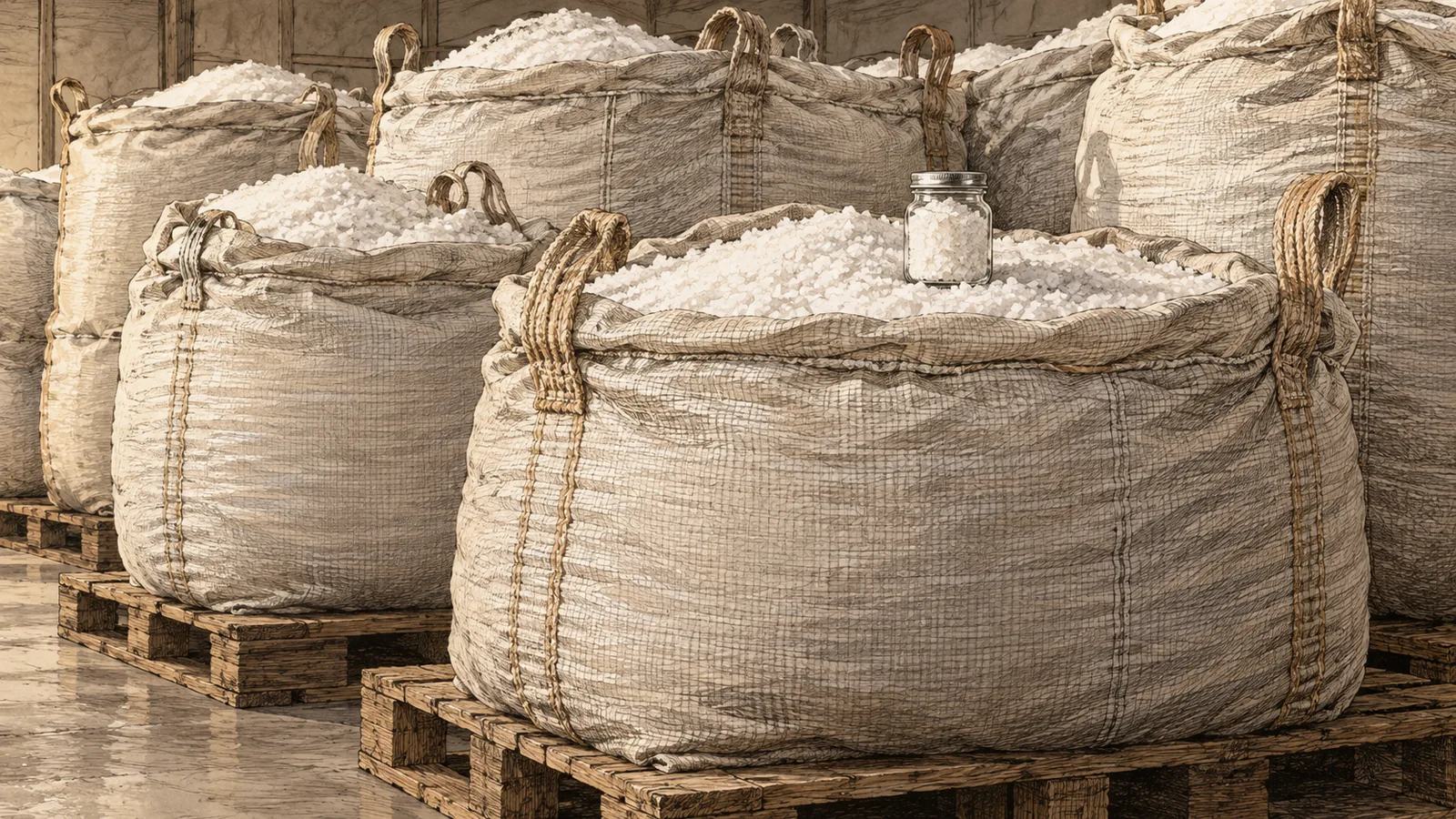
US salt leaves the plant at an average of $150 to $260 a tonne for the food-relevant grades, according to the US Geological Survey — roughly 2 cents per 100 g. On a supermarket shelf the same substance costs about 26 cents per 100 g as table salt, 46 cents as sea salt and $3.32 as a premium flake. Very little of that gap is salt. It is heat, packaging, freight and the margins of whoever handles the box on the way.
What does salt cost at the plant gate?
The only authoritative American number is the one the USGS publishes each year in its Mineral Commodity Summaries. The 2026 edition estimates that US producers sold or used 39 million tonnes of salt in 2025, worth about $2.6 billion. It also gives an average value per tonne for each of the four ways salt is made.
| USGS type | Share of 2025 output | 2024, $/t | 2025 (est.), $/t | Per 100 g, 2025 |
|---|---|---|---|---|
| Vacuum and open pan | 9% | 259.69 | 260 | 2.6¢ |
| Pond-evaporated (USGS category) | 9% | 152.87 | 150 | 1.5¢ |
| Rock salt | 38% | 52.95 | 54 | 0.54¢ |
| Salt in brine | 44% | 10.56 | 11 | 0.11¢ |
Read those numbers for what they are. They are averages across every grade and buyer, valued free on board at the mine or plant, and they mix bulk, pellets and packaged salt. The 2025 column is an estimate. None of them is a food-grade price, and most of the tonnage behind them goes into chemical plants and onto winter roads. We covered that in Most Salt Is Not for Eating.
The ladder still says something. Salt still dissolved in brine is worth $11 a tonne. Crystallised in a pond it is worth about $150. Boiled into a clean, dry crystal in a closed vessel it is worth about $260. Our reading — an inference, not a USGS finding — is that the gap between the last two rungs is roughly what heat costs, blurred by the different product mixes in each category. Vacuum salt is the expensive commodity, not the cheap one.
What does food-grade sea salt cost in bulk?
One published price: a 50 lb bag of Morton food-grade sea salt was listed by the online wholesaler All Bulk Foods at $43.41 on 24 September 2026. The listing gives the ingredient as sea salt, produced by evaporating Pacific seawater in ponds. That works out at $1.91 a kilo, or 19 cents per 100 g — about seven times the USGS vacuum-pan average and thirteen times the pond-salt average.
This is a small buyer’s price for one bag, not a contract price. A food manufacturer buying by the truckload pays less, and we could not find a published figure for what. The number is useful for a different reason. It is already within a few cents per 100 g of the supermarket canister below, which tells you where the money in commodity salt goes. Not into the salt.
What does salt cost on the shelf?
Three products, each from a live retailer listing, each converted to price per 100 g and compared with the USGS vacuum-pan average of 2.6 cents.
| Product | Retailer, date listed | Pack and price | Per 100 g | × USGS vacuum-pan value |
|---|---|---|---|---|
| Morton Iodized Table Salt | Walmart, 24 Sep 2026 | 26 oz (737 g), $1.92 | $0.26 | 10× |
| Morton All-Purpose Iodized Sea Salt | Walmart, 25 Sep 2026 | 26 oz (737 g), $3.42 | $0.46 | 18× |
| Maldon Sea Salt Flakes | Kroger, 25 Sep 2026 | 8.5 oz (240 g), $7.99 | $3.32 | 128× |
These are single-day online prices from two chains; they vary by store and will move. The ratios are the durable part.
The thing most people get wrong here is assuming the cheap salt carries the fat markup, because it is the one being sold in bulk to millions. It is the reverse. A canister of table salt sells at about ten times the average plant value of vacuum salt, after being packed, trucked, warehoused and shelved. That is a thin chain. The multiple of 128 belongs to the flake — a very different product made in open pans, as What Is Actually in Maldon explains.
Where does the markup happen, step by step?
Nine steps sit between seawater and a shelf. For some a public number exists. For others we found none, and we say so rather than fill the gap.
| Step | Best public figure | What kind of number it is |
|---|---|---|
| Harvest and evaporation | $11–$260 a tonne by type | USGS national average, f.o.b. plant |
| Washing | None found | Our estimate only |
| Grading | None found | Our estimate only |
| Drying | Folded into the vacuum-pan value | Inference from the USGS ladder |
| Smoking or blending | None found | Our estimate only |
| Packaging | 4 oz glass jar $0.50, cap about $0.29 | Catalogue price, small quantities |
| Freight | No lane rate cited | Our estimate only |
| Distributor | 13.7% gross profit rate | One wholesaler, company-wide |
| Retailer | 22.9% gross margin | One grocer, company-wide |
Harvest and evaporation
This is the step people imagine they are paying for, and it is the cheapest. For food salt the relevant USGS rungs are pond salt at $150 and vacuum salt at $260 a tonne: 1.5 to 2.6 cents per 100 g. A small hand-harvested operation will cost far more per tonne than those national averages, but nobody publishes those costs, and we will not guess at a named producer’s.
Washing, grading and drying
Many sea salts are rinsed in brine to shed sediment and some of the bitter magnesium salts, screened into grain sizes, and dried. We found no published per-tonne cost for any of the three. Our estimate, and it is only that: at industrial scale they are small next to packaging and freight. At small scale they are mostly labour. Grading has a second cost that rarely gets mentioned. Screening turns one harvest into several products, and the fines have to be sold somewhere, usually cheaper. How the process itself works is in How Sea Salt Is Made.
Smoking or blending
No public figure. What can be said is structural. A cold-smoked salt spends time in a chamber with wood, fuel, handling and some loss. A blend adds ingredients, and almost any dried herb, spice or vegetable costs more per kilo than salt, so the cost of a blend is set by what is not salt. We are developing smoked salts and blends ourselves; the question that development is trying to answer is flavour and process, and nothing about its economics belongs in this article.
Packaging
This is where retail salt’s price is decided. SKS Bottle & Packaging lists a 4 oz clear glass spice jar at $0.50 each by the case of 24, and matching red plastic caps with pressure-sensitive liners at $41.76 per 144, which is 29 cents each. That is 79 cents of empty glass and plastic, before a label, a shrink band, a shipping carton, or the freight to bring the empties to whoever fills them. Volume discounts take a few cents off.
A 118 ml jar holds something like 140 g of fine salt, and much less of flake — our estimate from typical bulk density, not a measurement. At the Walmart price above, 140 g of table salt sells for about 36 cents. The empty jar costs more than twice what the salt in it sells for. That is why commodity salt comes in a cardboard canister, and why any salt in a jar starts from a price floor the salt itself did not set.
Freight
Salt is dense and cheap, so freight is charged on its weight while the value per kilo stays tiny. A shipping container of salt fills by weight long before it fills by volume. Spread a container rate of a few thousand dollars over roughly 20 tonnes and the ocean leg comes to cents per kilo — our arithmetic, not a quoted lane rate. Against rock salt at about 5 cents a kilo, that would be several times the value of the cargo. Against a flake it is a rounding error. The expensive legs are the small ones: pallets rather than containers, and the final parcel to a kitchen.
Distributor and retailer
Here there are audited numbers, with a large caveat. UNFI, a US grocery wholesaler, reported a gross profit rate of 13.7% of net sales for the fourth quarter of its fiscal 2026. Kroger reported a gross margin of 22.9% of sales for 2025. Chained together at those rates, the wholesaler and the grocer account for about a third of the shelf price.
Both figures are company-wide averages across milk, meat, detergent and everything else. We would expect margins on a slow-moving specialty jar to run higher than on staples, but we could not find a published margin for salt specifically, so we have not invented one.
A worked example, and what it cannot tell you
Take a hypothetical flake salt priced at $3.32 per 100 g, the Kroger figure above, and run it back through those two averages. The grocer would have paid about $2.56. The wholesaler would have paid the maker about $2.21. Against that, 100 g of food-grade sea salt bought by the 50 lb bag costs 19 cents — under a tenth of what the maker receives. The other nine-tenths pay for the process, the labour, the box, the freight, the overheads and the maker’s own margin.
This is arithmetic on averages, not anyone’s accounts. It is not how Maldon, or any named maker, actually splits its price; none of them publishes that. It shows the shape of the chain, not its exact proportions.
So is premium salt overpriced?
It is priced for what it is: small-batch production, a particular crystal, and a small container. You can reasonably decide that a flake is not worth $3.32 per 100 g to you. You cannot reasonably conclude that someone is pocketing the difference between that and 2.6 cents, because most of the difference is packaging, handling and scale.
What a premium price does not buy is nutrition. Sodium chloride is sodium chloride at every rung of that ladder. A premium buys texture, process and presentation. Those are legitimate things to pay for. They are not what the label usually claims to be selling.
We are not publishing our own costs or prices. Gaucho is pre-launch, and those figures are neither settled nor public.
The weaknesses in our sourcing: the USGS 2025 values are estimates and mix bulk with packaged salt. The retail prices are single-day online listings from two retailers. The bulk price is one small-buyer listing, not a contract price. The distributor and retailer margins are company-wide, not specific to salt. For washing, grading, drying, smoking and freight we found no published figures, and everything we say about them is labelled as our estimate. If a producer publishes per-tonne processing costs, we would like to read them.
Sources
- USGS — Mineral Commodity Summaries 2026: Salt
- All Bulk Foods — Morton Sea Salt (Food Grade), 50 lb
- Walmart — Morton Iodized Table Salt, 26 oz
- Walmart — Morton All-Purpose Iodized Sea Salt, 26 oz
- Kroger — Maldon Sea Salt Flakes, 8.5 oz
- SKS Bottle & Packaging — 4 oz clear glass straight-sided spice jar
- UNFI — fourth quarter and full year fiscal 2026 results
- Kroger — fourth quarter and full-year 2025 results
Read next
- Most Salt Is Not for Eating — where most of the tonnage goes
- What Is Actually in Maldon — the flake in our price table, read from its paperwork
- Vacuum Salt and Recrystallised Sea Salt — the expensive commodity
- Patagonian Sea Salt — what our salt is and where it comes from
The Salt Guide
We are recording the salts on the American shelf one jar at a time — label, panel, price paid, crystal on white. Browse the guide →