
Vacuum Salt, Alberger and the Limits of Sea Salt
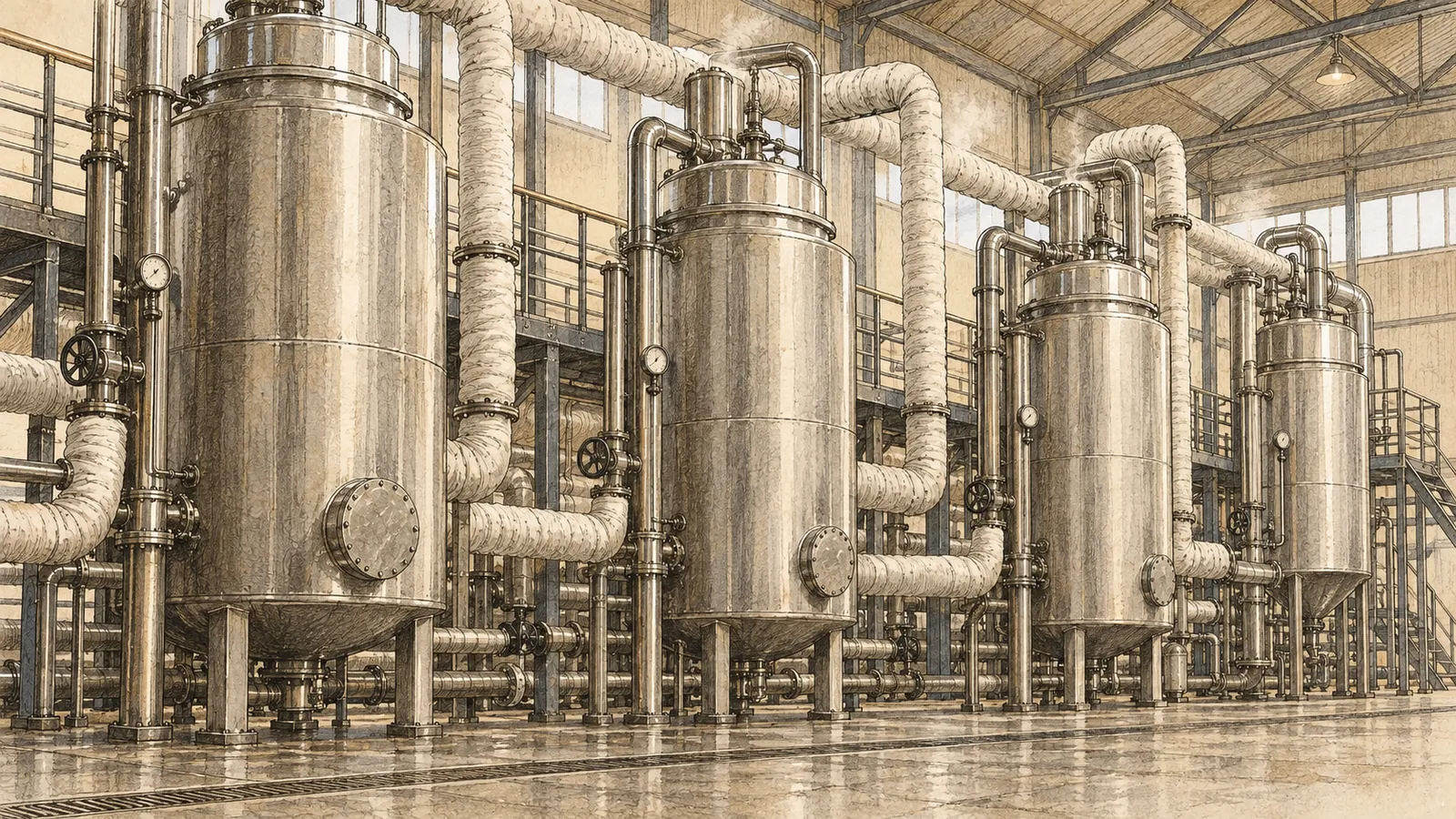
“Vacuum salt” describes a process, not an origin. Purified brine is boiled in closed vessels under reduced pressure, which lowers the boiling point and lets one vessel’s steam heat the next; the brine can come from the sea, from an underground bed dissolved on purpose, or from pond-grown salt dissolved again in seawater. Alberger is a different process entirely — an American method patented in 1915 that grows flake crystals in open grainer pans, and is the reason Diamond Crystal kosher salt looks the way it does. PVD is a trade abbreviation for “pure vacuum dried”, not a separate technology. None of the three words tells you which water the salt came out of.
What vacuum salt actually is
The physics is the whole trick. At reduced pressure brine boils cooler, so the vapour coming off one vessel is still hot enough to boil the brine in the next vessel — provided the next vessel is held at a lower pressure again. String enough of these together and you can boil the same tonne of water several times on one lot of fuel. The Salt Association describes modern UK plants running six effects, against three on the early Victorian evaporators, with first-effect pressures around 50 psi and saturated brine boiling at 109 °C.
Before any of that, the brine is cleaned. The main impurities are calcium, magnesium and sulphate. Calcium is precipitated as carbonate, magnesium as hydroxide, and sulphate is managed by operating conditions so that sodium sulphate does not crystallise out with the salt. That purification step is the reason vacuum salt is so consistent, and it is also the reason vacuum salt has almost nothing in it but sodium chloride.
The crystal is a fingerprint of the vessel. Older internal-calandria evaporators produced near-perfect cubes; modern forced-circulation designs with external calandrias produce cubes with rounded corners. An experienced eye can tell one plant’s salt from another’s. What you will never get from a vacuum pan is a flake, because the crystal grows suspended in agitated brine rather than at a still surface — which is the same reason flake salts need a quiet pan.
PVD is the same thing with an acronym
PVD stands for pure vacuum dried, sometimes written out as pure vacuum evaporated. It is the ordinary trade shorthand in India, East Africa and the Gulf for the product of the process above, usually iodised and packed for retail. We could not find any standards body that defines the abbreviation, so treat it as marketing vocabulary for a well-defined engineering process rather than as a specification you could hold a supplier to.
The important point is that PVD says nothing about the feedstock. A refinery can feed its evaporators with brine from a solution-mined rock bed, with natural underground brine, or with coastal salt that was crystallised in ponds, washed, and then dissolved again so the vacuum plant has something clean to boil.
Alberger is not vacuum salt
This is the conflation worth killing. The Alberger process was patented by Charles L. Weil in 1915. Brine is heated under pressure through a series of heaters, passed through a tank of granite cubes — the graveler — that strips unwanted material, and then the pressure is released so that crystals form in a steam-heated evaporation pan. Crystals nucleate at the surface and grow downward; the published account of the process gives the result as pyramid-shaped flake salt.
Cargill, which holds the Alberger trademark and makes the salt at St. Clair, Michigan, describes it differently, and the full sentence is the difficulty: “The Alberger method forms cubic crystals through a solution fed to grainer pans by partial vacuum-pan evaporation.” Cubic — on a page about a flake salt. The first half of that sentence is the interesting part.
The same page also says Alberger salt “consists of flakes of fine, multi-faceted crystals, whereas salt produced by other methods is typically composed of hard cubical grains”, and describes the seed crystals as forming “a crystalline structure that is a combination of the grainer-type flake”. One page, two incompatible descriptions of the same grain. The likeliest explanation is that “cubic” there means the crystal system rather than the shape of the grain — sodium chloride crystallises in the cubic system whatever the grain looks like — but that is our reading of a supplier’s page, not something Cargill says. We would rather leave the seam showing. What every account does agree on is that the grain is grown in an open grainer pan and not in a vacuum pan.
The output is familiar even if the name is not. Cargill’s Diamond Crystal sell sheet says the process “creates pyramid-shaped, jagged edged crystals” with “much greater surface area than standard granulated salts”, and its manufacturing-process page calls the Alberger result a “unique, hollow-shaped crystal”. Hollow comes from one Cargill page and pyramid from another, and no Cargill sentence we have found contains the phrase “hollow pyramid”. It is our compression of two of their claims. If you have ever wondered why Diamond Crystal crushes differently from other kosher salts, the answer is in that crystal, and it is a manufacturing answer. We have written about the rest of that category in kosher salt explained.
One more thing follows. Cargill’s own process page places Alberger in its evaporated-salt family, whose brine is made by injecting fresh water into an underground salt deposit and pumping the solution back up. On that reading Diamond Crystal is not a sea salt. Cargill does not claim it is.
Process, crystal, and what the label may say
| Process | Feedstock | Crystal | Can it be labelled sea salt? |
|---|---|---|---|
| Pond crystallisation | Seawater or coastal brine | Coarse, irregular, moist or dried | Yes |
| Heated pan | Seawater, concentrated first | Flakes and pyramids | Yes |
| Vacuum pan / PVD | Any purified brine | Small dense cubes, rounded corners | Only if the brine was marine |
| Alberger | Usually solution-mined brine | Pyramid-shaped flakes; the maker’s own page also says cubic | Generally no |
| Dissolve and recrystallise | Solid salt redissolved in seawater | Depends on the second crystalliser | Arguable, and disclosed by some |
The clearest worked example is Japanese
Hakata Salt is one of Japan’s best-known table salts and it publishes exactly what it does, which is rarer than it should be. The company buys pond salt imported from Guerrero Negro in Mexico and from Price in Australia, dissolves it in Japanese seawater, removes sand and other matter, and then, in its own words, “boil[s] down the concentrated brine into crystal salt”, followed by several days of natural drying. No chemical additives. Magnet filter, grader, colour screener, metal detector, visual inspection.
So the finished crystal genuinely formed in Japan, out of a liquor that genuinely contains Japanese seawater. It is also, unavoidably, mostly Mexican and Australian pond salt that has been through a crystalliser twice. That is a processed hybrid, and calling it a Japanese sea-salt harvest would be wrong. Hakata does not call it one.
Why Japan builds salt this way
Not by preference. In 1971 Japan enacted a law on modernising salt production that effectively prohibited the traditional salt-field methods and mandated the ion-exchange membrane process, in which electrodialysis concentrates seawater before it is boiled. The state salt monopoly was abolished in 1997, and from April 2002 producers were free to choose their own raw salt. Hakata, having built its business around imported pond salt, kept doing it.
Underneath the law is the weather. Japan is humid and rains a great deal; open-air pond crystallisation is slow and unreliable there in a way it is not on an arid coast. Britain answered the same problem with heated pans, Iceland with geothermal heat, and Japan with electrodialysis and imports. These are all responses to climate, and none of them is a moral position.
The dissolve-and-refine pattern is enormous
India is the scale case. Tata Consumer Products states plainly that its flagship uses vacuum evaporation technology and that the brand “pioneered salt iodization in the country, bringing an iodized vacuum-evaporated salt into a market where unbranded, unpackaged salt was the norm”. The same company markets a separate crystal line which it describes quite differently: sourced from the sea, crystallised in ponds, and hygienically packed. Two products, one brand, two entirely different manufacturing stories, both disclosed on the same page. Similar vertically connected systems run in China, Indonesia, Kenya and New Zealand: pond salt in at one end, washed, dissolved, vacuum-refined, iodised and boxed at the other.
This is the bulk of the world’s edible salt. It is clean, cheap, iodised where public health requires it, and dull in exactly the way an industrial input is supposed to be dull.
“Cargill salt” is not one thing either
Cargill runs four processes: pond crystallisation, mechanical rock mining, solution-mined evaporated salt, and Alberger. Its San Francisco Bay works at Newark is a genuine marine operation, and the company’s own account of it is a good corrective to anyone who thinks pond salt is quick — Bay water takes three to five years to work through the pond sequence before harvest, after which the crystals go through a series of washes, an optical sorter, magnets and screens. The dossier we work from said roughly three years; Cargill says three to five, and Cargill is the better source on its own ponds.
The company therefore sells marine pond salt, rock salt, solution-mined vacuum salt and Alberger flakes under one corporate name. The brand is not the provenance. That is the same point we made about kosher salt and sea salt, arriving from the industrial side.
Where ours sits, and what that costs
Our salt is none of the above. It is crystallised once, from Patagonian seawater, by the low-temperature process our producer publishes, and it is not washed, not dissolved again and not vacuum-refined. The consequences are real and some of them are inconvenient: the crystal is less uniform than a vacuum cube, the moisture and mineral content move between lots, and it costs far more per kilogram than PVD salt does.
Those are facts about texture and cost. They are not a verdict on anybody else’s process. A vacuum plant that produces a uniform, iodised, cheap crystal for a hundred million kitchens is solving a harder problem than we are, and solving it well. What we object to is only the vocabulary — the way “sea salt” on a front label can survive a dissolve, a refine and a second crystallisation in another hemisphere, with nothing on the pack to say so. Grain size you can see. Process history you cannot.
Our own gap, disclosed: we describe our producer’s method only as the low-temperature process they publish, because they have not confirmed times or temperatures to us in writing. Every process figure in this article belongs to somebody else and is sourced below. We would rather print a hole than fill it in.
Sources
- The Salt Association — the vacuum process
- The Salt Association — vacuum evaporator design and operation
- Cargill — salt manufacturing processes
- Cargill — how sea salt is made, San Francisco Bay
- Cargill — Alberger brand salt, crystal form and functionality
- Cargill — Diamond Crystal Kosher Salt sell sheet, pyramid-shaped crystals
- Alberger process — Weil patent of 1915, graveler and grainer pan
- Hakata Salt — raw materials, dissolution in Japanese seawater and recrystallisation
Read next
- How Sea Salt Is Made — the first crystallisation, in detail
- Sea Salt vs Kosher Salt — two words that describe different things
- Fine, Coarse or Crystal? — what grain size does and does not change
- Patagonian Sea Salt — crystallised once, and what that costs
The Salt Guide
We are recording the salts on the American shelf one jar at a time — label, panel, price paid, crystal on white. Browse the guide →