
Piran Salt and the Petola
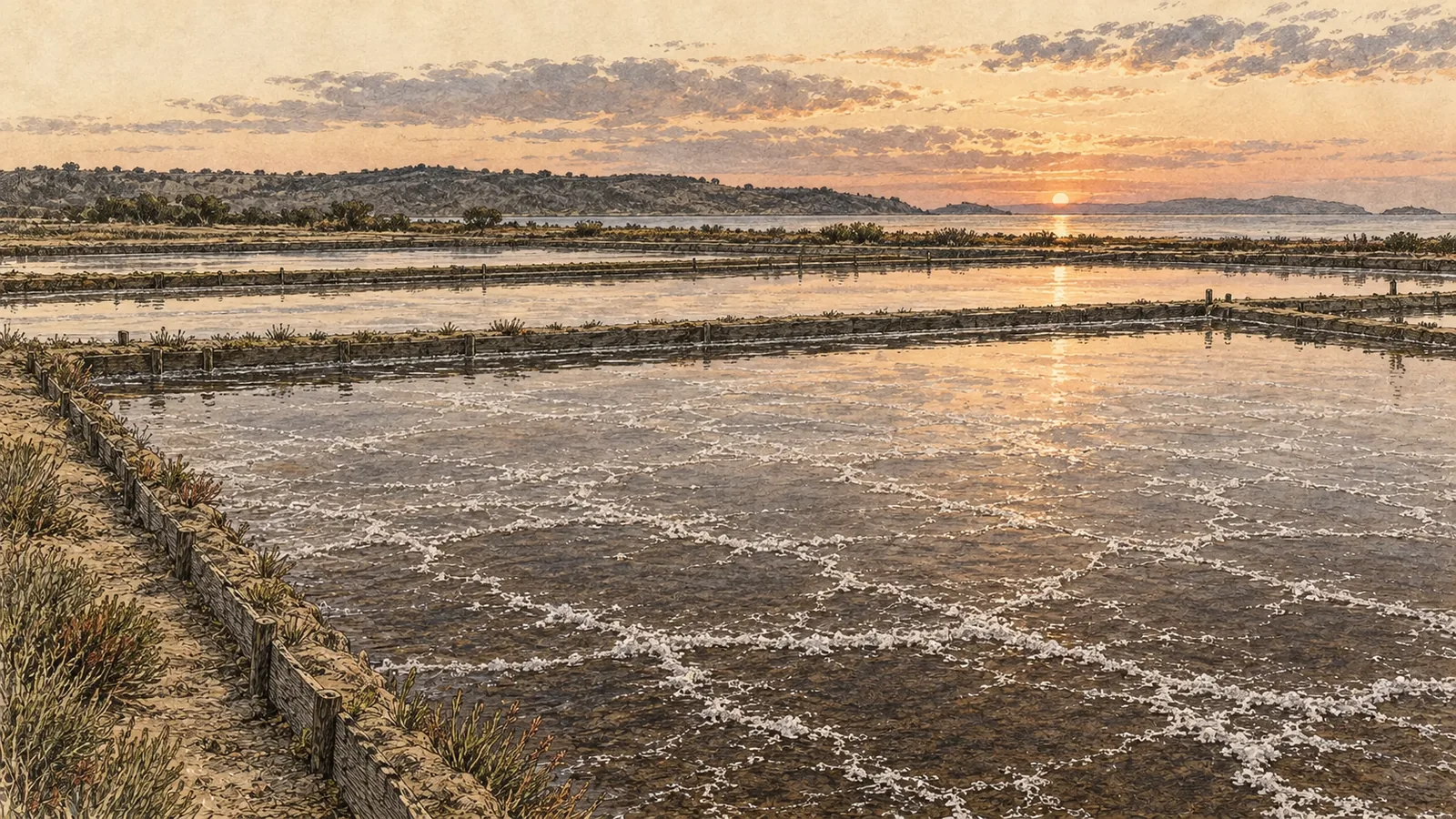
Piran salt is protected by a European PDO whose specification turns on a layer the salt workers grow themselves. The petola is a one-centimetre crust of cyanobacteria, gypsum, carbonates and, to a lesser extent, clay, cultivated on the floor of each crystallisation basin between the end of one season and the start of the next. It keeps the crystals off the sea mud and, the specification says, acts as a biological filter against traces of heavy metals. It is the only cultivated pond floor we can find written into any protected salt specification.
What the petola actually is
Most people reading a salt label assume the floor of an evaporation pond is a container. Water goes in, water leaves, salt is left behind, and the floor is whatever the ground happens to be. That is a reasonable assumption and it is how a great many saltworks operate.
Piran does not work that way. The application document published in the Official Journal in December 2013 describes the petola as an artificially cultivated crust about a centimetre thick, made of cyanobacteria together with gypsum, carbonates and a smaller fraction of clay. It has to be kept level, because an uneven floor gives uneven brine depth and uneven brine depth gives uneven crystals. Preparing it is not a one-off act of construction. The specification puts the work in a window running from the end of the previous season until crystallisation begins, every year.
The stated function is twofold. It separates the growing salt from the silt beneath, which is what keeps the product white rather than grey. And the document credits it with holding back heavy-metal traces that would otherwise settle into the crystals. The second claim is the specification’s, not ours, and we have not seen the underlying work that supports it. We would read it as the reason the specification also sets hard ceilings on lead, cadmium, arsenic, mercury and copper — the filter is asserted, the numbers are tested.
The numbers the specification sets
This is where Piran stops being a folk story and becomes a document. The registered specification sets composition, not just place and method:
- sodium chloride, on dry weight, minimum 95 per cent
- magnesium, minimum 0.2 per cent; calcium, minimum 0.1 per cent
- bulk density before storage, maximum 950 kg/m³
- crystal size that “generally does not exceed 6.3 mm”
- lead under 2 mg/kg, cadmium under 0.5, arsenic under 0.5, mercury under 0.1, copper under 2
- not refined and not rinsed during production
Read the magnesium figure carefully. It is a regulatory floor, not a typical analysis. It says what a producer may not go below if the word on the packet is going to be Piranska sol. It does not say what any given bag contains, and it is not comparable, decimal for decimal, with a manufacturer’s data sheet.
The floor is nonetheless the interesting part, because it is the same number Wales uses. The Halen Môn PDO specification also sets magnesium at a minimum of 0.2 per cent, alongside sodium chloride above 90 per cent and calcium in a band of 0.08 to 0.15 per cent. Halen Môn is the specification usually reached for when anyone wants to show that a protected name can pin down composition and not merely place, and the reasons are unremarkable: it is recent, it is British and it is published in English. Piran has at least as good a claim and is cited far less. It sets the same magnesium floor, a higher sodium chloride floor and a calcium floor as well, and the two registrations are four months apart — the Anglesey regulation adopted in December 2013, the Piran one in April 2014. Neither of them, incidentally, does what Argentina’s food code does, which is to fix a composition for a whole category of sea salt while protecting no name at all.
A mineral floor is a processing rule
A minimum magnesium content is not a nutrition rule and nobody should read it as one. Magnesium salts are bitter in quantity and they draw damp, which is precisely why industrial processing removes them. A floor under magnesium is therefore a floor under restraint: it forbids the washing and refining that would strip the crystal clean.
Which is why the Piran specification’s plainest sentence is the one about not rinsing. The composition rule and the process rule are the same rule, written twice.
How four protected salts treat the floor and the finish
| Protected name | Pond floor | Cultivated? | Washing and drying | Composition in the spec |
|---|---|---|---|---|
| Piranska sol (PDO, 2014) | Petola: cyanobacteria, gypsum, carbonates, clay, about 1 cm | Yes, rebuilt and levelled each year | Not refined, not rinsed | NaCl min 95% dry, Mg min 0.2%, Ca min 0.1% |
| Sel de Guérande / Fleur de sel de Guérande (PGI, 2012) | Natural clay of the marsh, worked into basins | No cultivation in the specification | Not washed after harvest, not refined, no additives | Insoluble matter ≤1% (≤0.20% for fleur de sel); moisture ≤12% |
| Sale Marino di Trapani (PGI, 2012) | Basins in a sequence of communicating reservoirs | No | Counter-current washing in saturated brine, centrifuging, oven drying to as high as 250 °C permitted | No additives, bleaches or anti-caking agents |
| Anglesey Sea Salt / Halen Môn (PDO, 2014) | None — vacuum evaporator and crystallising tanks | Not applicable | Hand-rinsed in concentrated brine, oven dried at 85 °C | NaCl >90%, Mg min 0.2%, Ca 0.08–0.15%, water <4% |
Set Guérande against Piran and the difference is exact. Both rest their case on the floor. Guérande’s argument is geological: the clay is impermeable, it holds heat into the night, and it is why salt could be made there at all. Nothing in the French single document asks anyone to grow anything. Piran’s argument is biological, and the specification makes the growing compulsory. If you have read our piece on sel gris, you already know the grey comes from the clay floor lifting into the rake. Piran is the same physics with the opposite objective: the floor is engineered so that nothing lifts.
Trapani is the useful third case, because it shows how much a protected name can permit. The Sicilian PGI allows washing in saturated brine, centrifuging and oven drying at temperatures that would be unrecognisable to a Guérande paludier. It is still a PGI. It is still protected. The seal is not a ranking, and anyone who reads it as one is reading a logo instead of a specification. That is the whole argument of the companion piece on protected origin.
Where the method came from
The Piran salt pans are old and the documentation is unusually good. The park’s own history dates the first record of salt-making at Piran to 804, and by the thirteenth and fourteenth centuries there were three complexes: Fazan at Lucija, Strunjan, and Sečovlje. The petola method is dated to 1358, brought in from the island of Pag, and it is the moment white salt on a gypsum-and-microbial substrate replaced whatever came before.
That is a company-and-park account of its own history, and we would treat the year as the tradition’s own claim rather than as an independently audited fact. The EU single document repeats it: salt workers from Pag, fourteenth century, petola cultivation.
The part that is harder to say
The romantic version of Piran is a medieval landscape worked unchanged for seven hundred years. The record is more interesting than that.
Research published by the Slovenian Academy of Sciences and Arts describes a 593-hectare saltworks in which production continues in the Lera section using methods modernised in 1912, while the Fontanigge section stopped producing in 1967 and has been decaying since. The same work counts 493 salt houses in the mid-nineteenth century, 118 by 1984, and about 70 ruins by 2019, and describes only a handful of living producers still working the fully traditional method. The salt pans and the nature park are both run under state concession by SOLINE Pridelava soli d.o.o., a company held within the Slovenian telecoms group, which the authors argue has subordinated the cultural heritage to the biodiversity case.
None of that invalidates the PDO. The specification governs the salt sold under the name, and the petola requirement applies to that salt. But “unchanged for 700 years” is marketing shorthand for something more like a living industrial site that has been partly mechanised, partly abandoned and partly preserved, and which now earns money from a nature park and a spa as well as from salt.
What the PDO does not cover
SOLINE sells Piran salt with the protected designation, and it also sells a traditional fine iodised sea salt, a range of herb and smoked salts, and solni cvet — the salt flower, the Slovenian fleur de sel. Only the first carries the PDO name on the pack.
That is not a trick. It is how protected designations work everywhere: the name is constrained, the company is not. A producer may make several things in the same pans and label only the one that meets the specification. The reader’s job is to notice which product in front of them is the protected one. If you want the general case, our fleur de sel piece covers what that surface crust is and is not.
Why any of this matters to a cook
Because the petola is the clearest proof in the whole industry that the pond floor is a manufacturing input. Not a container, not scenery: an input, specified, maintained, and legally enforceable. Every argument grey salt makes about the clay it is raked from rests on the same claim, usually without a document behind it. Piran has the document.
What the petola does not do is make Piran salt better than salt made on a clean floor. It makes it a particular salt, made a particular way, with a name that can be taken away if the way changes. That is a deliberate design choice and a defensible one. It is not an accident and it is not a shortcoming.
Two caveats on our own reading. First, we have worked from the single document published in the Official Journal and from the Commission register entry, not from the full Slovenian national specification, which is where any further detail on testing and control would sit. Second, the heavy-metal filtering function attributed to the petola is a claim made in the specification; we have not located the underlying research and we are not in a position to check it. On our own salt: we are not protected by anything. There is no Patagonian designation, and we would rather say that than imply one.
Sources
- EUR-Lex — publication of the application for Piranska sol PDO, OJ C 353, 3 December 2013
- EUR-Lex — Commission Implementing Regulation (EU) No 436/2014, entering Piranska sol in the register
- European Commission — Piranska sol PDO
- SOLINE Pridelava soli — Piranska sol / Piran salt
- Sečovlje Salina Nature Park — history of the salt pans
- ZRC SAZU — Sečovlje salt pans: heritagisation of culture or nature?
- INAO — single document, Sel de Guérande / Fleur de sel de Guérande PGI
- UK GI scheme — Halen Môn PDO product specification
Read next
- PDO, PGI, DO: Which Sea Salts Have Protected Names — the full register, in one table
- What Is Sel Gris — the other argument about pond floors
- What Is Actually in Maldon — a famous salt with no protection at all
- Patagonian Sea Salt — ours, unprotected, and said so
The Salt Guide
We are recording the salts on the American shelf one jar at a time — label, panel, price paid, crystal on white. Browse the guide →