
Who Makes Sea Salt in North America
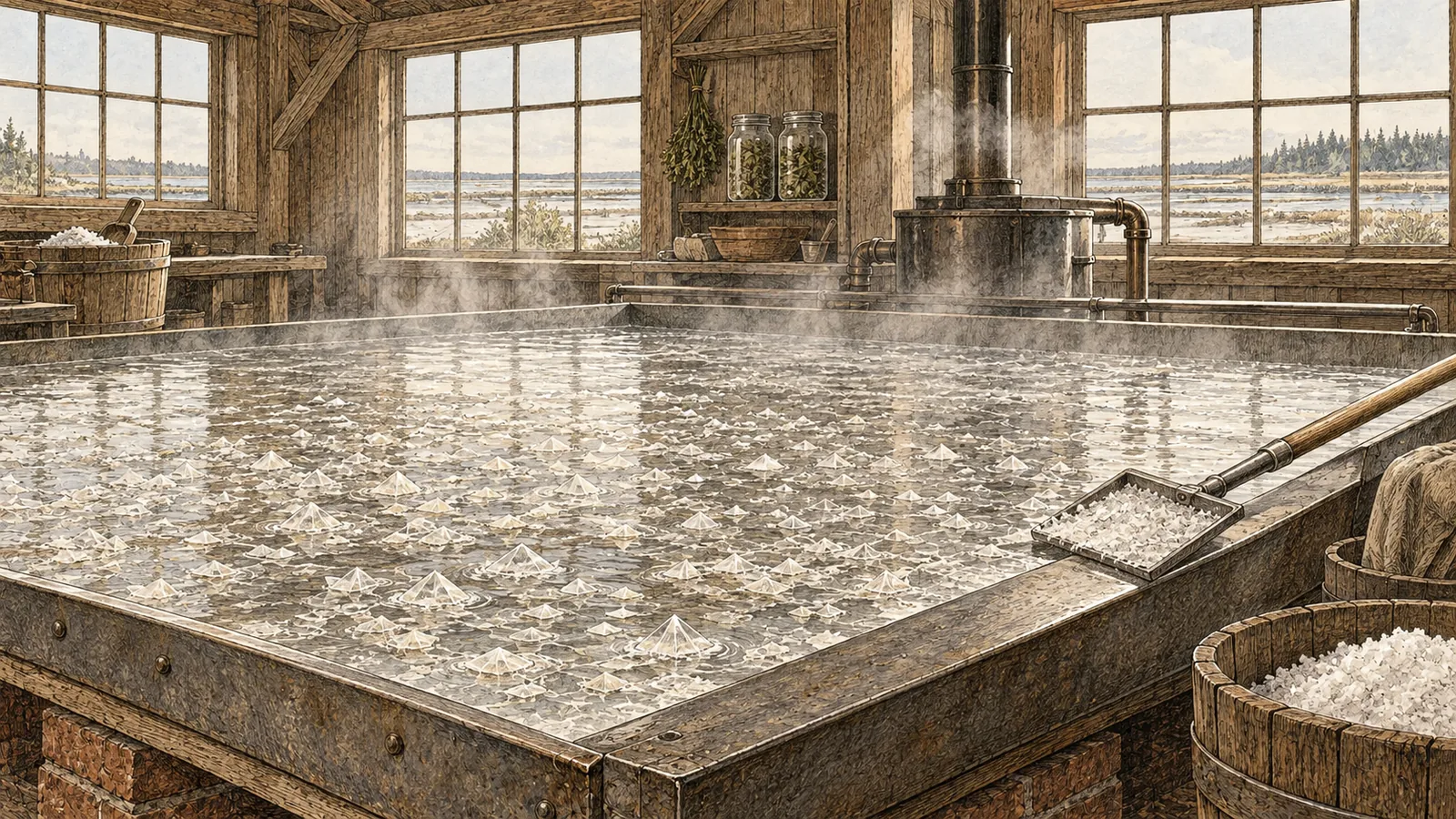
A handful of operations in the United States and Canada turn local seawater into edible salt on site. We are not going to tell you how many, because nobody keeps a register and we did not count them. The best documented, Jacobsen Salt Co., makes flake and kosher salt from Netarts Bay in Oregon and states on its own FAQ that its fine salt is harvested by partners in Trapani, Italy. The largest marine saltworks on the continent is Mexican, at Guerrero Negro, and its owner prints that none of its product is suitable for human consumption. The disclosure is what to admire, not the flag on the tin.
Why we will not give you a number
The obvious way to open an article like this is with a count. A dozen. Fewer than you think. We drafted that sentence and deleted it. No register exists to count from, and the category will not hold still.
Take the clearest case. Maine Sea Salt Company of Marshfield, Maine appears on nearly every list of American salt makers ever published. Its founder, Stephen Cook, died in April 2024; a storm the previous December had destroyed most of the evaporation structures; the town clerk told the Bangor Daily News the business was permanently closed. The website went on taking orders and charging cards afterwards. A working checkout is not evidence that anyone is making salt. Note too that Maine Sea Salt Company and Maine Salt Farm are two different companies — the first, in Marshfield, is closed; the second, in Cape Elizabeth, is trading and is in the table. They are conflated constantly.
What we checked, and what we could not
Every entry in the table was read against the company’s own website in September 2026, with two exceptions we would rather name than bury.
- Bulls Bay Saltworks loaded for us only intermittently. We saw its shop and its one-line account of its method. Its town, water body and greenhouse detail come from Discover South Carolina, the state tourism agency, not from the company.
- Alaska Pure Sea Salt Co. was the reverse: its source page opened, its shop pages did not, so we have its account of the water and no sight of its catalogue.
Otherwise the method given is the company’s own and nothing else. Where a producer discloses no outside source we have written that it discloses none, which is not the same as proving there is none. We did not stand in any of these buildings. This is the list we could document, not a census.
| Maker | Water, as published | Method, as published | Made elsewhere |
|---|---|---|---|
| Jacobsen Salt Co., Tillamook, Oregon | Netarts Bay | Pumped, filtered, reverse osmosis, boiled down, crystallised in heated pans | Yes — Pure Italian Fine Sea Salt, Trapani |
| Maine Salt Farm, Cape Elizabeth, Maine | Gulf of Maine | Filtered Atlantic water evaporated in stages in dedicated houses, late spring to early autumn | None disclosed |
| Bulls Bay Saltworks, McClellanville, South Carolina | Bulls Bay, inside the Cape Romain National Wildlife Refuge | Greenhouse the owners call the Solar Tunnel; four weeks or less depending on temperature | None disclosed |
| Alaska Pure Sea Salt Co., Sitka, Alaska | “The pristine waters surrounding Sitka”; no narrower body named | Hand crafted from seawater; the company states nothing else is added | None disclosed |
| San Juan Island Sea Salt, Friday Harbor, Washington | A private beach at the south end of San Juan Island, May to late September | Filtered to one micron, evaporated to dryness in ponds inside fourteen salthouses over roughly a month | None disclosed |
| Amagansett Sea Salt Co., Amagansett, New York | Atlantic Ocean, collected “bucket by bucket” | Purpose-built salterns; crystals tended and hand harvested, year-round | None disclosed |
| Kona Sea Salt, Kailua-Kona, Hawaii | Deep ocean water from below 2,200 ft off Keahole Point | Enclosed evaporation over about four weeks | None disclosed |
| Newfoundland Salt Company, Bonavista, Newfoundland | Trinity Bay | Boiled down in fast pots, crystallised in slow pots, hand harvested | None disclosed |
Jacobsen is the case worth studying
On its FAQ the company writes: “Our Pure Italian Fine Sea Salt is harvested by our partners in Trapani, Italy, in open-air salt ponds fed by the Mediterranean Sea.” The Oregon account on the same page is equally specific: pumped, filtered, through a reverse osmosis machine, boiled down so excess minerals drop out, crystallised in custom pans. Full pyramids become flake; the rest becomes kosher salt.
Read what that costs them. Jacobsen built a brand on the Oregon coast, and the grain a home cook reaches for most is not made there. They could have stayed quiet; nobody was going to audit the crystal. A brand can be legitimate without owning a pond. What it cannot do is let the name of a place stand in for a chain of custody it does not have. Disclosure is not a confession. It is collateral.
The small ones, and what they are actually doing
The pattern across the rest is climate, not philosophy. Maine Salt Farm evaporates in stages from late spring to early autumn, which is the limiting fact: a cold coast with a short season cannot run all year. San Juan Island Sea Salt has the same problem and the same answer, gathering from one beach between May and late September. Its description of the equipment is worth the price of admission: “No heaters, no fans, no nothing.”
Bulls Bay gets round the season with a building: four weeks or less, inside the greenhouse the owners call the Solar Tunnel. Amagansett works the Atlantic off the east end of Long Island and says it runs year-round. Alaska Pure is the plainest-spoken of the group — seawater in, nothing added. Newfoundland Salt Company boils Trinity Bay water hard and crystallises it slowly, the same two-stage logic as a graduation house arriving from the other direction. Cold coasts end up boiling. Warm ones end up waiting. Neither is a virtue.
Kona Sea Salt is the outlier. Its water is not surface seawater: it is drawn from below 2,200 ft through a pipeline the company gives as 6,284 ft long and 40 in across. Those are company figures, not independent measurements, and the claim that the water is around nine hundred years old is a company claim too. The depth is a different intake problem, not a different chemistry.
Hawaii is a separate tradition, not a saltworks
The Hanapepe salt ponds on Kauai belong here only to be taken off the list. Hawaii Sea Grant, which has run a hydrogeologic study of the site, describes salt making as one of Hawaii’s oldest traditions and calls Hanapepe “one of the last places in all of Hawai‘i that continues this tradition following these methods”. That is a carefully different sentence from the one we first published, which called it the oldest continuously worked site in the islands. We could not source that, so it is gone.
The rule about selling is clearer. Reporting on the ponds puts it flatly: the salt cannot be bought or sold, only given or traded, and the pans are worked by a fixed set of Native Hawaiian families. A jar of red salt on a mainland shelf did not come from there; what the colour actually is, we cover in Hawaiian Salt, Red and Black. “Hawaiian sea salt” on a label usually describes a recipe and a colour, occasionally a farm like Kona, and almost never Hanapepe — the same failure mode as every other origin word on a salt package.
The industrial half of the same continent
Cargill’s Newark works on San Francisco Bay gives more than 12,000 acres of ponds capable of crystallising 500,000 tons a year. Handle those carefully. Twelve thousand acres is a footprint. Five hundred thousand tons is capacity, not output. Residence time is quoted two ways on Cargill’s own pages: about three years in one place, “between three and five years for a sea salt crop” in another. That range is not sloppiness. It is what happens when the process variable is the sky.
Mexico is larger again, which is why this page says North America. Exportadora de Sal at Guerrero Negro, Baja California Sur, describes itself as the largest salt facility in the world, roughly 33,000 hectares with capacity above 8.0 million tons a year, wholly Mexican-owned since February 2024, most of it going to the chlor-alkali industry. Its booklet carries the line that settles whether it belongs in the table: “NO PRODUCT IS SUITABLE FOR HUMAN CONSUMPTION OR THE FOOD INDUSTRY AND ITS DERIVATIVES.” A producer telling you in capitals not to eat its salt is the cleanest disclosure here. Where the world’s salt goes is the subject of Most Salt Is Not for Eating.
What the list is actually telling you
- The word on the front is the least informative thing on the package. Netarts Bay, the Gulf of Maine, Bulls Bay, a beach on San Juan Island, Trinity Bay and a pipe 2,200 ft down are all “sea salt”, and so is a Newark pond open to the air for three years.
- Method decides texture; water decides almost nothing you can taste. A boiled pot flake and a greenhouse crystal from the same ocean are different products, as we set out in How Sea Salt Is Made.
- Disclosure is the only variable a buyer can check. You cannot audit a pond from a laptop. You can read what a company says about each of its SKUs, and notice when it declines.
We are an importer. We do not make salt; we buy it from a producer on the Chubut coast and say so in What Is Patagonian Sea Salt. The flag is not the argument. Jacobsen earns its place at the top because it published the inconvenient half of its own supply chain. That is a deliberate choice and a defensible one. It is not modesty and it is not a shortcoming.
Our own weak point, stated plainly: for every small producer here we rely on company self-description, because no third party audits a saltworks’ origin claims the way one audits its food safety. An earlier version of this page said we had verified that every operation was trading. We had not, and the Marshfield case shows how easy that mistake is.
Sources
- Jacobsen Salt Co — FAQ, Trapani disclosure and Netarts Bay method
- Maine Salt Farm — process and address
- Bangor Daily News — Maine Sea Salt Company closed
- Bulls Bay Saltworks — company site and shop
- Discover South Carolina — Bulls Bay Saltworks
- Alaska Pure Sea Salt Company — our source
- San Juan Island Sea Salt — our process
- Amagansett Sea Salt Co — the salt
- Kona Sea Salt — intake depth and pipeline
- Newfoundland Salt Company — Trinity Bay
- Cargill — San Francisco Bay salt ponds
- Cargill — three to five years per sea salt crop
- Exportadora de Sal — company booklet
- Hawaii Sea Grant — Hanapepe salt pond study
- Honolulu Civil Beat — Hanapepe salt making
Read next
- Hawaiian Salt, Red and Black — what the colour actually is
- Where Salt Is Made — the world map, not one continent
- How Sea Salt Is Made — pond, pan and vacuum side by side
- Patagonian Sea Salt — our own chain of custody
The Salt Guide
We are recording the salts on the American shelf one jar at a time — label, panel, price paid, crystal on white. Browse the guide →