
Korean Tidal-Flat Salt: Shinan and Taepyeong
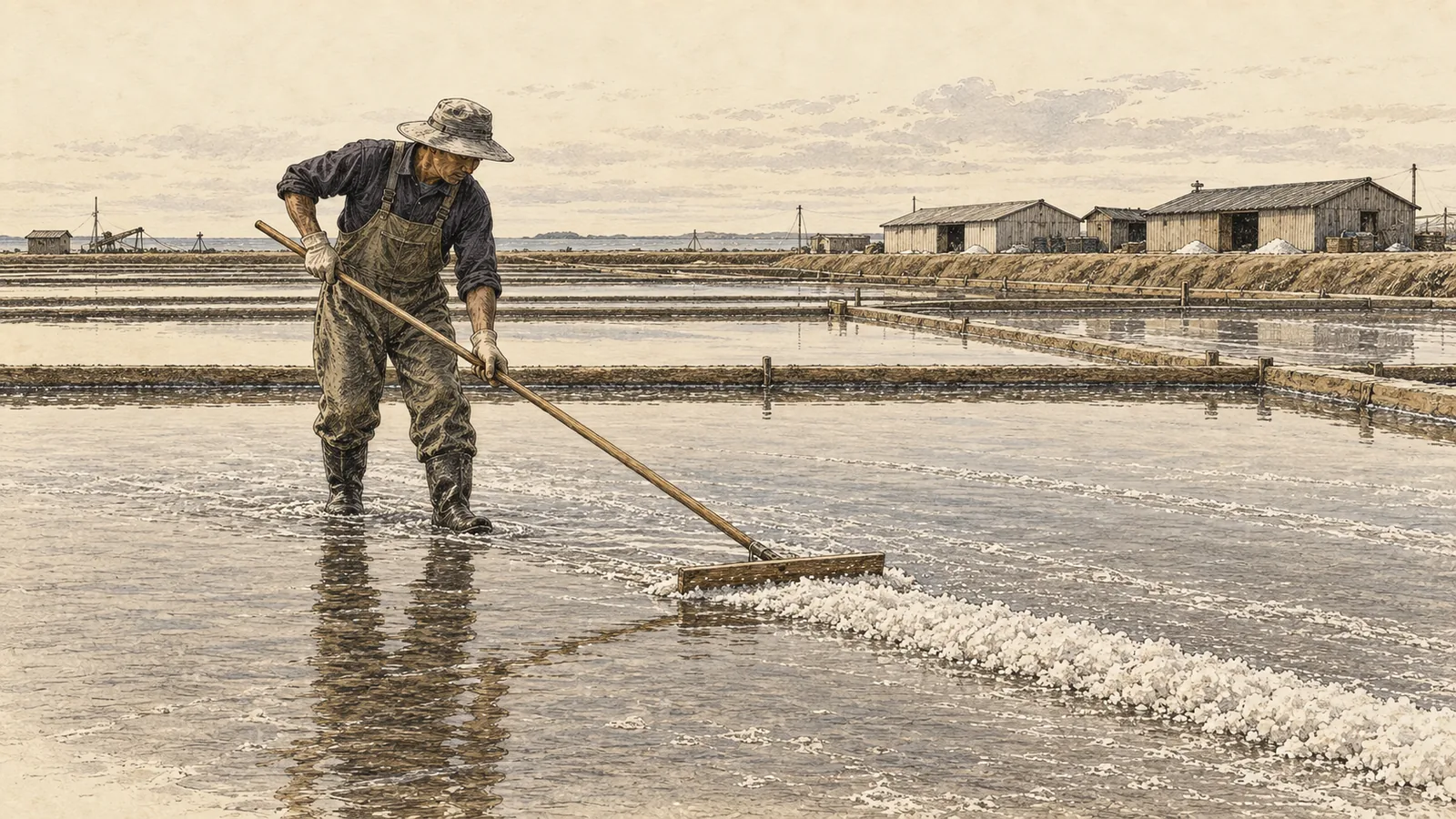
Korean cheonilyeom is coarse, damp solar salt harvested from shallow beds laid out on the tidal flats of the Yellow Sea, overwhelmingly in Sinan County. Two things about it are routinely misreported. The method is not ancient — Korea’s own heritage service dates its introduction to 1907, and it holds no geographical indication: what Korea protects is the craft, listed as National Intangible Cultural Heritage No. 134 in 2018. Since 2 April 2025 the country’s largest farm has been under a US Withhold Release Order: an instruction to detain its sea salt at the border on information that reasonably indicates forced labour in production — a detention an importer can rebut, not a finding of guilt and not a ban on the company.
How the salt is actually made
The system runs on tides and gravity rather than pumps. Seawater is admitted through sluice gates at high tide into a holding reservoir, then moved by stages across a grid of shallow, embanked ponds cut into the flat. Each stage is saltier than the last. Korea.net’s account of the Sinan salterns gives the sequence in numbers: seawater collected at around 3 per cent salt concentration turns to 5 to 6 per cent at the first evaporating site, then rises to 11 per cent at the second, and only then reaches the crystallising site. Crystals of 3 mm or thicker form over about fifteen days, are raked up, and go into warehouses to drain.
The salt is not finished when it leaves the pond. It is wet, and it carries bittern — the residual mother liquor of magnesium and other chlorides trapped around the crystals. The warehouse phase is the product.
It is not an ancient tradition, and that is more interesting
This is the thing most readers are wrong about, and the mistake is very reasonable: the ponds look old, the tools are wooden, and the marketing leans hard on continuity. Korea’s heritage service is blunter than the marketing. Its listing for Jeyeom, Traditional Salt Making, explains that Korea had no salt mines and drew all its salt from seawater, and distinguishes two methods. Jayeom, or boiled salt, was made by drawing high-concentration brine from the mudflats and boiling it down. Cheonilyeom, solar salt, “was introduced to Korea in 1907 and has been practiced until today.”
So the pond method is a little over a century old on that coast. The genuinely old Korean salt tradition is the boiled one. Both are covered by the designation.
What is protected, and what is not
Three separate designations get blurred together in English-language writing about Korean salt. They protect different things and two of them do not protect the salt at all.
| Designation | Year | What it covers | What it does not do |
|---|---|---|---|
| Jeyeom — Traditional Salt Making, National Intangible Cultural Heritage No. 134 | Designated 30 April 2018 | The craft of making salt, both boiled and solar | Does not restrict who may sell “Korean sea salt”, or set a composition |
| Taepyeong Salt Farm, state-registered modern cultural property No. 360 | Registered 22 November 2007 | One named saltern on Jeungdo and its stone salt warehouse | Protects a site, not a product category |
| Getbol, Korean Tidal Flats, UNESCO World Heritage | Inscribed 2021, extended 2026 | A natural inscription under criterion (x) — biodiversity and migratory birds | Makes no mention of salt farming whatsoever |
The UNESCO point is the one most often stretched. Getbol is on the list for the ecology of the mudflats; the inscription text counts species, not salterns. A salt farm sitting inside or beside a World Heritage tidal flat has not been recognised by UNESCO for its salt.
And there is a straightforward absence. We looked for a registered geographical indication covering Korean solar salt, of the kind that protects fleur de sel de Guérande or Anglesey sea salt, and did not find one. We will not assert that none exists — a negative is hard to prove — but if there is one, it is not being cited by the people selling the salt. On present evidence Korean solar salt is protected as a practice and as a place, not as a name.
Where it comes from
Sinan County, an archipelago off the south-western tip of the peninsula, has an estimated 800 salt farms across tidal flats of roughly 378 square kilometres. The Korea Herald puts the wider South Jeolla province’s output at up to 70 per cent of the nation’s production.
Taepyeong — romanised Taepyung by the company and in the US order below — is on Jeungdo, and is the largest. The Korea Times, reporting the US order, gave it as founded in 1953, covering 4.62 million square metres and producing about 6 per cent of Korea’s total sea salt — press figures, not an audited return, and not ones we found in any government release. The company’s own site sets out the island’s cluster of designations — Asia’s first Slow City, a UNESCO biosphere reserve, a Ramsar wetland listed in September 2011, and modern cultural property No. 360.
The floor of the pond
The crystallising bed is where Korean salt gets compared to French grey salt, and where the comparison needs care. Two bed types are distinguished in Korean practice: topanyeom, harvested from a bare earth floor, and jangpanyeom, harvested from a floor lined with synthetic sheeting or tile. Slow Food’s Ark of Taste entry for Sinan topanyeom says the earth-floor method takes longer than the alternatives, which is why the salt is expensive, and that its small producers have struggled since salt production around Sinan intensified in the 1970s.
We flag that as a reported distinction rather than a measured one. We have not found it set out in a government specification or an audited producer standard. What it does establish is that the brief version — “Korean salt is harvested from the mud” — is only true of part of the output, and probably the smaller part. Most of it appears to crystallise on a lined floor. That is a manufacturing decision, and it is the same kind of decision that separates sel gris, raked off a clay bottom, from a salt raked off a sealed one. Two mud-coast traditions arriving at broadly similar crystals from opposite sides of the world — but only where the Korean farm has kept the bare floor.
What it does in a kitchen
Korean coarse salt is bought for brining, for kimchi and for the soybean ferments — ganjang and doenjang. The relevant properties are physical.
It is coarse, in crystals of several millimetres. It is damp, because it is minimally processed and never dried hard. And it is aged: the Korea Herald’s account of the Sinan trade notes that the salt usually reaches the market once the bitterness has gone, which takes about a year. Longer ageing — three years, five years — is very widely claimed by sellers and by Korean cooking writers, and we have not been able to tie any specific ageing period to a producer specification or an independent standard.
The cooking consequences are real and dull. A damp coarse crystal dissolves more slowly than a dry fine one, which is what you want when drawing water out of cabbage over hours rather than seasoning at the pass. A spoonful of it weighs less than a spoonful of fine salt and much less than a spoonful of dense dry crystals, so a volume measure written for one will not transfer. Weigh it. We set out the general version of this problem in fine, coarse or crystal, and the pond mechanics in how sea salt is made.
What we will not do is the next paragraph you usually get. Korean bay salt is marketed heavily on its mineral content and on what that content is supposed to do for you. We make no claim of any kind about minerals, health, nutrition or benefit, for this salt or for ours. The moisture and the coarseness change how the salt behaves in a brine. That is a cooking fact. It is not a nutrition fact, and it is not evidence of one.
The part the marketing leaves out
On 2 April 2025, US Customs and Border Protection issued a Withhold Release Order against sea salt produced by Taepyung Salt Farm, acting under 19 U.S.C. § 1307, which bars import of goods produced wholly or in part by convict, forced or indentured labour. CBP’s notice states the order rests on information reasonably indicating the use of forced labour in production; it does not itemise the indicators. The bulletin instructs officers at all US ports of entry to detain sea salt sourced from the farm; an importer may then show a shipment is admissible or export it, and exclusion or seizure follows only if that proof is not produced.
The background is long. Korean authorities identified 63 victims of labour abuse on Sinan salt farms in 2014, most of them people with developmental disabilities, in cases involving unpaid wages. In October 2025 the Korea Times reported that Taepyeong had asked the Korea Heritage Service to delist both the farm and its Salt Gallery, arguing that the site’s social value had been severely undermined by the allegations. Sinan County had begun reviewing; the case then goes to the province and on to the heritage service. The registration was still live when we checked.
A joint statement by human rights groups in March 2026 said the order was still in effect a year on, and we have found no CBP notice modifying or revoking it since. Be careful what that establishes. A Withhold Release Order names one producer and authorises detention; it is not a court judgment, and it is not a statement about any particular lot of Korean salt on a US shelf. Sinan has hundreds of farms. But an article about Korean tidal-flat salt that discusses heritage listings and fermentation and omits this would be a brochure.
What to take from it
Korean solar salt is a real, distinctive, working product: coarse, moist, aged, and made by a method younger than most people assume. It is protected as a craft and as a landscape, not as a name. Its largest producer is under an active US border-detention order, which is not the same thing as a verdict. Every one of those sentences is checkable, and none of them is a reason to admire it less or more.
On our own limits here: we have not visited Sinan, we do not read Korean, and every source below is either an English-language government page or English-language reporting, which means we are reading a filtered record. The topanyeom and jangpanyeom distinction rests on an Ark of Taste entry and press accounts rather than a specification. The ageing periods are trade convention. And we sell salt ourselves, from a coast several oceans away, so treat this as a comparison written by an interested party. The wider geography is in where salt is made.
Sources
- Korea Heritage Service — Jeyeom (Traditional Salt Making), National Intangible Cultural Heritage No. 134
- UNESCO World Heritage Centre — Getbol, Korean Tidal Flats
- US Customs and Border Protection, CSMS #64637741 — Withhold Release Order on Taepyung Salt Farm sea salt
- The Korea Times — the US order, the farm’s size and output share, and the 2014 cases
- The Korea Times — Korea’s largest salt farm seeks delisting from the national heritage register
- Korea.net — Sinan-gun tidal flats, saltern stages and farm numbers
- The Korea Herald — Salt of the earth in Sinan, Yeonggwang
- Taepyung Salt — Jeungdo designations, cultural property No. 360 and Ramsar listing
Read next
- What Is Sel Gris — the other mud-floor tradition, and an older one
- How Sea Salt Is Made — the pond sequence that every solar saltern shares
- Where Salt Is Made — why some coasts can do this and others cannot
- Patagonian Coarse Salt — our coarse grain, for comparison
The Salt Guide
We are recording the salts on the American shelf one jar at a time — label, panel, price paid, crystal on white. Browse the guide →